Cédric Charbit CEO, Saint Laurent
+91 97699 99960 im@digantsharma.com Sign out

HomeStrategy & Vision

05  Strategic editorial

Planning a house that outlives the plan

Luxury is one of the few consumer industries in which the planning horizon that matters most is longer than the tenure of almost everyone doing the planning. What follows is an account of how houses are actually built over that horizon — the questions that recur, the trade-offs that cannot be avoided, and the difference between a strategy and a list of intentions.

Industry context — not attributed to Cédric Charbit

Three clocks

The horizons a house is run on

Most strategic confusion in fashion comes from arguing about decisions that belong to different time horizons as though they belonged to the same one.

01 · Weeks to months

The season

Delivery, sell-through, replenishment, markdown discipline, store staffing. Almost entirely executional, highly measurable, and the level at which the business feels most urgent. It is also the level at which the least durable value is created.

02 · One to three years

The cycle

Category architecture, price ladder, store network shape, wholesale-to-retail balance, organisational design. This is where most of what is called strategy actually lives: decisions that are reversible in principle but expensive in practice.

03 · Five to twenty years

The house

Identity, craft capability, cultural position, the meaning the name carries. Almost nothing at this level can be measured within a reporting period, which is precisely why it is the level most often deferred.

04 · The failure

Borrowing forward

Almost every serious brand injury in the sector has the same structure: a horizon-three asset spent to solve a horizon-one problem. Discounting to hit a quarter, licensing to fill a gap, expanding distribution to buy volume — each rational in isolation, each paid for later.

05 · The discipline

Naming the horizon

The practical corrective is unglamorous: state, for every significant decision, which horizon it belongs to and which one it is being funded from. Most bad trade-offs are made invisibly rather than deliberately.

06 · The test

What survives a bad year

A strategy is only real to the extent that it survives a period in which the numbers argue against it. Everything that is abandoned in the first difficult quarter was, in retrospect, an intention rather than a strategy.

Strategic themes

01 · Long-term brand building

A brand is a promise that has been kept often enough to be assumed. That is the whole mechanism, and it explains both why brand equity takes so long to build and why it can be lost quickly: a single broken promise is more informative than a hundred kept ones.

Building over decades therefore has less to do with communication than with consistency of behaviour — the same quality standard when nobody is checking, the same pricing discipline when volume is available at a discount, the same refusal to appear in contexts that do not fit. None of these produce a measurable return in the period in which they are paid for.

The most useful practical distinction is between awareness, which can be bought, and authority, which cannot. Houses that confuse the two spend heavily on visibility and are surprised to find it does not convert into pricing power. Authority is accumulated through demonstrated competence — craft, service, judgement — and it is the thing that allows a price to be held.

One consequence is that the most valuable strategic decisions are often decisions not to do something: not to open in a market that is not ready, not to extend into a category the house cannot execute well, not to accept a partnership that would be lucrative and slightly off-key. These decisions never appear in a results presentation.

02 · Strategic focus

Focus is the least discussed and most decisive variable in the sector. Large houses have more good opportunities than they have organisational capacity to pursue, and the binding constraint is attention rather than money.

In practice, focus shows up as a small number of things the leadership is willing to be repetitive about. Repetition is uncomfortable for executives — it feels unsophisticated — and it is the mechanism by which a priority actually reaches a store manager in a market the leadership visits twice a year.

The second element is sequencing. Organisations absorb change at a finite rate. Attempting three transformations simultaneously does not deliver them three times faster; it delivers none of them and exhausts the capacity to attempt a fourth. Deciding which comes first, and accepting that the others wait, is the substance of the work.

The third is defending the focus against its own success. Once a priority begins to work, every adjacent opportunity acquires a plausible case for inclusion. This is how a focused programme becomes a portfolio of initiatives within eighteen months, usually without anyone deciding that it should.

03 · International expansion

Expansion is easy to measure and hard to judge. Store count, market entries and distribution points all move in the right direction on a chart while telling you very little about whether the brand is stronger.

The more revealing measures are productivity and repeat. A network of fewer, better stores with high sales density and a growing base of returning clients is worth more than a larger network of thin ones — and it is considerably harder to build, because it cannot be accelerated by signing leases.

Sequencing matters at the market level too. Entering a market before the brand has cultural presence there means paying for awareness through retail, which is the most expensive channel available. Entering after presence has been built — through culture, press, travel retail or simply the customers who already know the house from abroad — is materially cheaper and tends to produce better locations on better terms.

The recurring error is treating a market's size as a measure of its readiness. A large market in which the house has no established meaning is not an opportunity; it is a construction project with a long payback and a high probability of being abandoned halfway.

04 · Organisational transformation

Most transformation programmes in the sector are structural rather than cultural in origin: the organisation was designed for a business that no longer exists — a wholesale-led business, a single-market business, a business in which digital was a department.

Reorganisation done well changes who is in the room when a decision is made. Done badly, it changes the chart and leaves the decision-making untouched, at which point the organisation quietly reconstructs its old routes through informal channels.

A useful diagnostic is to trace a single decision — say, how many units of a given style will be produced — and count how many functions must agree, how long it takes, and where it can be overturned. The answer usually explains more about a house's performance than any strategy document.

The cost of transformation is almost always paid in the same currency: a period of reduced output while people learn new routes. Programmes that do not budget for that dip tend to be judged a failure at exactly the point they are beginning to work.

05 · Cultural relevance

Relevance cannot be manufactured on demand, but it can be cultivated — and it can certainly be destroyed. The houses that hold it over long periods tend to behave less like advertisers and more like patrons: sustained relationships with artists, musicians, film-makers and institutions, maintained through periods when there is nothing to launch.

The distinction that matters is between renting attention and being granted it. A campaign rents; a decade-long relationship with a photographer, a foundation or a music scene is granted. The first is faster and disappears; the second compounds.

Cultural presence also carries an asymmetry that is easy to underestimate. A house that positions itself inside contemporary conversation is judged by the standards of that conversation, and the scrutiny arrives with the relevance rather than after it. The capability required is therefore not only curatorial but institutional: the ability to respond well when something goes wrong.

Underneath all of it sits a simple question that no amount of programming answers on a house's behalf: what does this brand actually think? Relevance follows a point of view far more reliably than a point of view follows relevance.

06 · Innovation

Innovation in luxury is unusual in that it is rarely about novelty. The customer is not asking for new categories of object; they are asking for the existing ones to be better made, better served and better understood.

The genuinely productive areas tend to be invisible from outside: materials and finishing, supply-chain responsiveness, traceability, client data used to serve rather than to target, and the operational plumbing that lets a store fulfil an order it does not physically hold.

Where innovation becomes visible, it is usually in service — the quality of the relationship after the sale, repair and restoration, the treatment of a client's history with the house as something worth remembering. These are old ideas being executed at a scale that used to be impossible.

The constraint is credibility. A luxury house adopting a new technology is judged against the standard of its craft, not against the standard of technology companies. Anything that reads as unfinished damages more than it gains, which is why the sector is right to be slower than it is often accused of being.

07 · The creative–business balance

The framing of creativity and commerce as opponents is the most persistent misunderstanding in the industry. In a functioning house they are not in tension over the same territory; they are answering different questions, and the failure is almost always that one has been asked to answer the other's.

Creativity answers: what should this house say, and what would be worth making that does not exist yet? Commerce answers: at what scale, in what quantity, at what price, for whom, and how does it reach them intact? Neither question is subordinate. Neither can be answered by the other's methods.

Where the two genuinely conflict — and they do — the conflict is usually about proportion rather than principle: how much of the collection is permitted to be uncommercial, how far a price may sit above the market, how much of the calendar is reserved for work that will not sell. These are legitimate negotiations with no permanent answer, which is why the relationship requires renegotiation rather than resolution.

The healthiest arrangement observed across the sector tends to have three features: clear and separate authority, genuinely long tenure on both sides, and an agreement to argue privately and present a single position publicly. Where those are present, the balance mostly looks after itself. Where they are absent, no governance structure substitutes for them.

Cédric Charbit speaking and gesturing during a Business of Fashion conference session
01Speaking at an industry conference.

The public register

Strategy in the open

Luxury executives speak in public more than they used to. Conference stages, industry summits and recorded conversations have become part of the job — partly because the sector's audience now expects the people running houses to be legible, and partly because a brand's positioning is increasingly argued in public rather than implied through product alone.

It is a demanding register. What is said on a stage is heard simultaneously by customers, employees, journalists, competitors and investors, each reading it against a different set of interests, and it is preserved indefinitely.

Industry perspectives

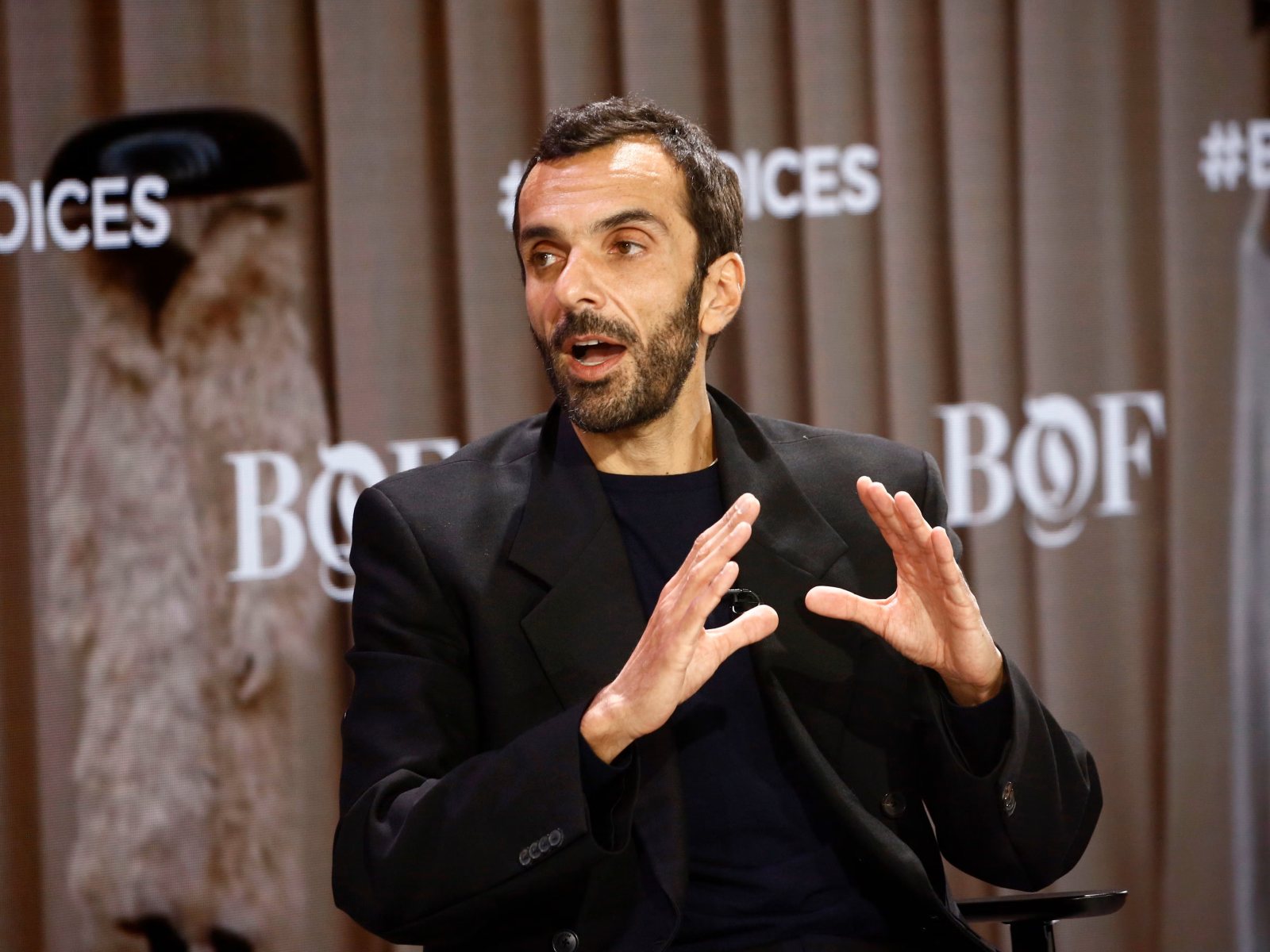
Cédric Charbit seated during a panel discussion in front of a conference backdrop
02Panel discussion, industry conference.

Continue

Luxury & brand development

Identity, heritage and innovation, global relevance, creativity and commerce — how luxury brands are actually developed over time.