Cédric Charbit CEO, Saint Laurent
+91 97699 99960 im@digantsharma.com Sign out

HomeIndustry Perspectives

07  Thought leadership

Reading the sector

Six analytical pieces on the forces that have reshaped global luxury over the past decade — written as industry commentary. Where figures appear, they are drawn from published company reporting and are attributed. Nothing on this page is presented as a statement, quotation or personal opinion of Cédric Charbit.

Editorial analysis — independently written for this website

Published figures

Four numbers, with their sources

€14.68bn

Kering group revenue, 2025

€14,675 million, down 10% on a comparable basis. Source: Kering full-year 2025 results.

€2.64bn

Saint Laurent revenue, 2025

Down 8% as reported and 6% on a comparable basis. Source: Kering full-year 2025 results.

20.0%

Saint Laurent recurring operating margin, 2025

On recurring operating income of €529 million, held level with 2024. Source: Kering full-year 2025 results.

53 yrs

Balenciaga's interval without couture

Between the closure of the founder's atelier in 1968 and the house's return to haute couture in July 2021. Widely reported.

These are company and house figures. They describe the businesses referred to on this site; they are not presented as a measure of any individual's performance.

Perspectives

i

The evolution of global luxury

From leather-goods engine to cultural enterprise

For most of the modern era, the economics of a European luxury house were straightforward to describe. A small number of category winners — a bag, a shoe, a jacket — generated the majority of the margin, and everything else in the business existed to support the conditions under which those objects could be sold at their price: the show, the store, the campaign, the archive.

That model has not disappeared, but it has stopped being sufficient. The customer base widened, then fragmented. Resale created a secondary market that publishes, in effect, a running valuation of every product a house has made. Social platforms made the brand's image a collaborative document. And the category winners themselves became harder to establish, because attention now disperses faster than a product development cycle can respond.

What replaced the old certainty is a more demanding proposition: a house must now hold a cultural position as well as a commercial one, and the two are not automatically aligned. A brand can be culturally central and commercially fragile, or commercially robust and culturally invisible — and the second condition is more dangerous over a decade, because it erodes the permission to charge the price.

The managerial consequence is a widening of the chief executive's brief. The role now routinely includes questions that used to sit outside it — which artists a house works with, what it says about its supply chain, how it behaves when a campaign is criticised. These are not communications matters. They are the terms on which the brand is currently permitted to operate.
ii

Changing consumer expectations

The client who already knows the price you paid

The single biggest change in the luxury customer is not demographic. It is informational. A client entering a store today may know the item's resale value, its production country, its price in three other currencies, and what a hundred strangers thought of it — before a sales associate has spoken.

This has quietly changed what a store is for. It is no longer primarily a place of discovery, because discovery has already happened. It is a place of confirmation and of service: the client is testing whether the object justifies what they already believe about it, and whether the house treats them in a way that matches its price.

Expectations of transparency have risen in parallel, and unevenly. Customers now routinely expect to know where something was made and under what conditions, while simultaneously expecting the mystique that has always been part of what they are buying. Houses have to satisfy both, which usually means being specific about process and restrained about explanation.

The most consequential shift, though, is in patience. Younger clients in particular extend a brand less credit for its history and more for its current behaviour. Heritage is treated as an interesting fact rather than an argument. A house that expects its past to carry it will find that it does not, and will usually discover this two seasons after it began to matter.

iii

Creative leadership

The designer, the chief executive and the space between them

The creative director–chief executive pairing has become the defining structural relationship in fashion, and the industry's most closely watched. Almost every major repositioning of the last two decades has been narrated through one of these partnerships, and almost every visible failure has been read as the breakdown of one.

What makes the arrangement unusual is that neither party can substitute for the other and neither reports meaningfully to the other in practice. The creative director owns a domain the chief executive cannot enter without damaging it; the chief executive owns conditions the creative director generally does not want to manage. The relationship is therefore a negotiation between two authorities rather than a hierarchy.

The durable pairings tend to share three characteristics. They last — long enough for a creative direction to be tested across several cycles rather than judged on its first season. They are explicit about authority — who decides what, stated rather than assumed. And they are private about disagreement, which matters because a visible split between the two is read by the market as a statement about the brand's future.

The industry's structural problem is that its incentives run against duration. Results are reported quarterly, creative direction is judged in months, and the pressure to announce a change is strongest at exactly the moment when persistence would be most valuable. Houses that resist this tend to do so because someone above the house — a group, a family, a board — is willing to absorb the interim.

iv

International brand management

Growth stopped being a single direction

For a long stretch, the sector's growth had an address. A dominant market absorbed the majority of incremental demand, and international strategy could reasonably be reduced to a question of how quickly to build there.

The pattern since has been less concentrated and more volatile. Recent reporting from the major groups describes strength in one region offsetting softness in another within the same quarter — Kering's 2025 results, for example, noted stable fourth-quarter sales at Saint Laurent on a comparable basis, supported by growth in North America and a return to positive territory in Western Europe, against a full-year decline.

For brand management, dispersion changes what good looks like. A house whose demand is broadly distributed is worth more than one of equivalent size concentrated in a single market, because its revenue is less correlated with any one economy, currency or regulatory change. Building that distribution is slow and expensive and does not show up in any single period's numbers.

It also raises the value of consistency. A client who buys in three cities across a year is now common, and they experience the house as one entity. Every inconsistency in price, assortment or service that used to be invisible because customers stayed in one market is now legible — and is read, correctly, as evidence about how the house is run.

v

Digital transformation

The brand is no longer only written by the brand

The early corporate framing of digital — as an additional sales channel requiring an additional department — has aged badly. What actually happened is that the digital layer became the medium in which nearly all brand encounters now occur, whether or not a transaction follows.

This produces a specific loss of control that houses have found difficult. A campaign is published, then immediately re-cut, re-captioned, parodied, praised and argued about by people the brand did not commission. The house still sets the terms of the original, but it no longer controls the reproduction, and the reproduction is what most people actually see.

The operational side has been more straightforwardly beneficial. Inventory visible across a network, orders fulfilled from wherever stock sits, client histories that actually follow the client between stores and countries, and a level of supply-chain traceability that was not previously achievable — these are unglamorous and have improved both margin and service.

The open question is data. The technical capability to know a great deal about a client has arrived faster than any settled view about how much a luxury house should use. The same information can produce service that feels attentive or attention that feels intrusive, and the line sits in a different place in different markets — which makes it a governance question rather than a technology one.

vi

Heritage & innovation

What an archive is actually for

Every house with a history eventually faces the same question: is the archive a resource or a museum? The answer determines whether the past functions as capability or as constraint.

The museum use is quotation — a print revived, a silhouette referenced, an old logo recovered because a decade has become fashionable again. It reliably produces a season of recognition and rarely produces anything that lasts, because what is being sold is the audience's memory rather than the house's competence.

The resource use is methodological. Archives record not only what was made but how a problem was solved: a construction that removed a seam, a proportion that changed how a garment moved, a refusal to compromise on a finish. Recovering that reasoning gives a house something it can apply to problems its founder never saw.

Balenciaga's return to haute couture in July 2021 — the house's first couture collection in fifty-three years, presented under Demna's creative direction — is a well-documented example of the second approach. Re-opening a discipline requires ateliers, trained hands and a place in the calendar, and it justifies itself less through its own revenue than through what it restores upstream: a standard against which everything else the house makes can be measured.

Innovation, on this reading, is not heritage's opposite. It is the same standard applied to materials, traceability, service and fit that did not exist when the standard was set. The two only appear to conflict when heritage is treated as an image rather than a practice.

Fashion & culture

Where the industry meets the art world

Luxury's relationship with contemporary art and culture is conducted largely in person — at openings, prizes, foundations and dinners. It is one of the few parts of the business that still runs on presence.

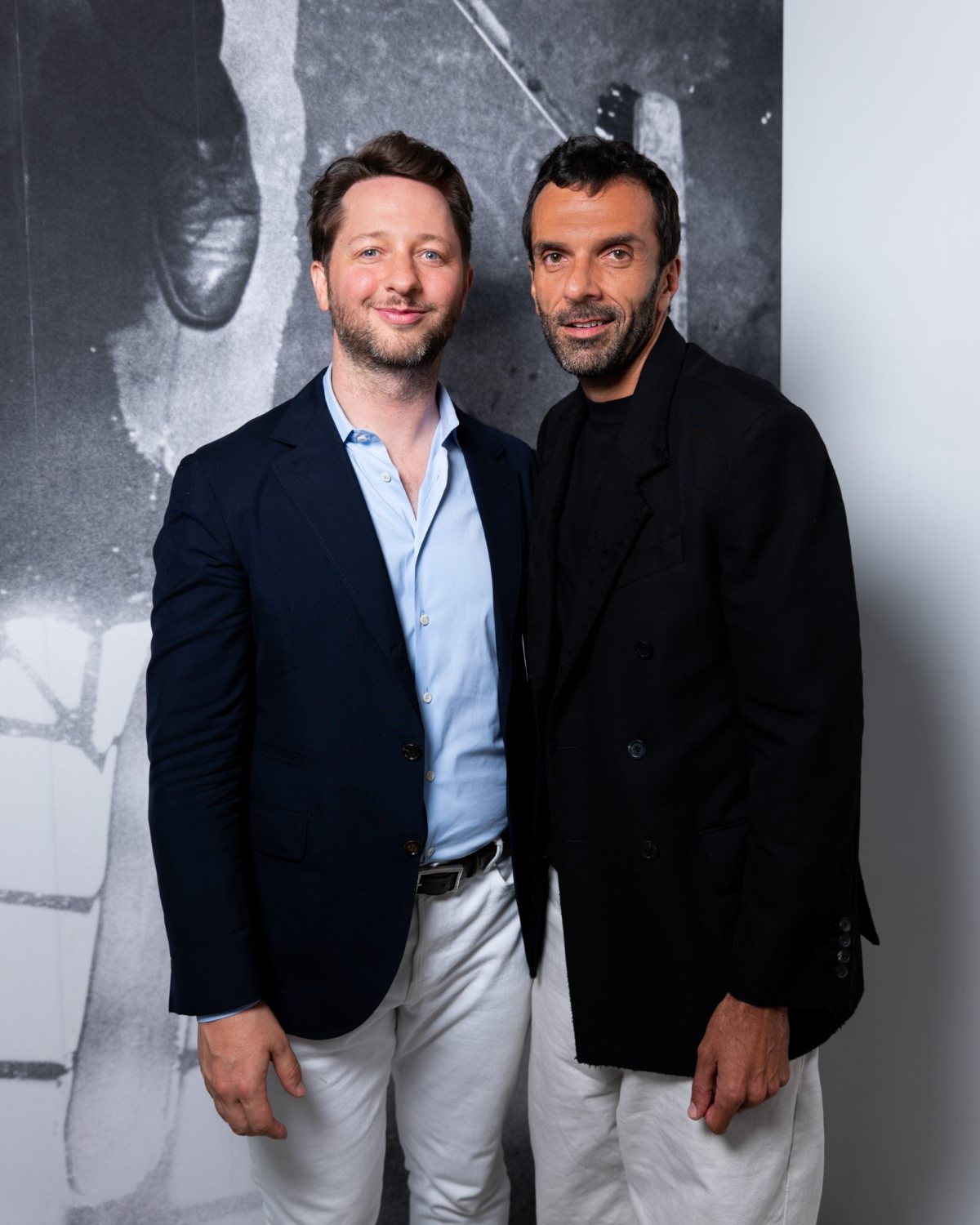
Cédric Charbit standing beside Derek Blasberg in front of a large black and white artwork at a Gagosian gallery event in Paris
01With Derek Blasberg at a Gagosian event, Paris.
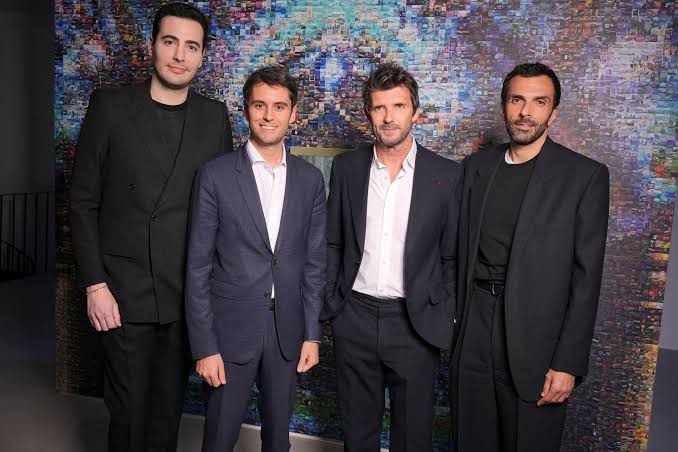
Cédric Charbit, at right, photographed with three other guests in front of a large illuminated screen at an industry event
02At an industry gathering.

The Paris industry maintains an unusually dense network of institutions — prizes, foundations, galleries and schools — through which the next generation of designers is funded, trained and made visible. Established houses participate in that network not only as patrons but as employers of the people it produces.

It is a form of infrastructure that does not appear on any balance sheet and that the sector depends on more than it usually says.

Continue

Media & gallery

A visual archive of appearances, portraits and industry occasions.