Cédric Charbit CEO, Saint Laurent
+91 97699 99960 im@digantsharma.com Sign out

HomeLeadership

04  Editorial analysis

Running a house

The chief executive of a luxury maison holds an unusual brief: accountable for a business whose most valuable asset — the belief people hold about the brand — cannot be manufactured, purchased or scheduled.

Industry context — not attributed to Cédric Charbit

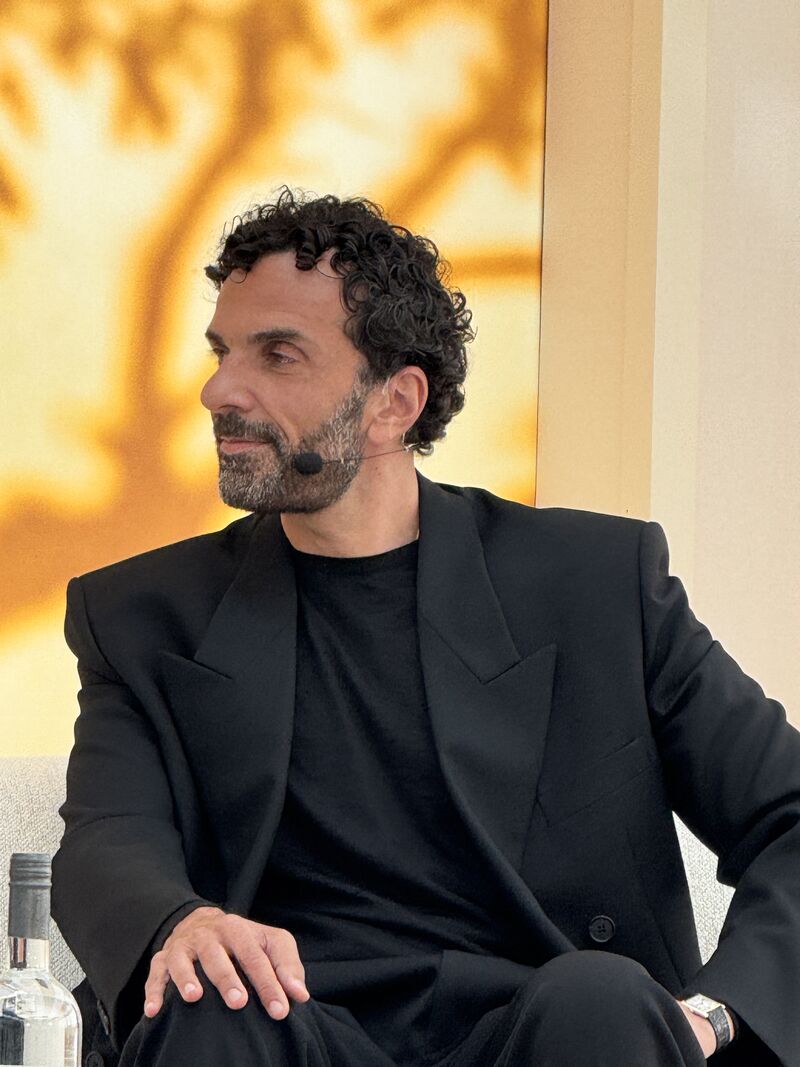
Cédric Charbit seated in a black suit wearing a headset microphone during an on-stage conversation
01In conversation at an industry event.

How to read this page

The sections below set out how the leadership of creative organisations is generally understood and practised across the luxury sector. They are editorial analysis prepared for this website. They describe the territory in which Cédric Charbit works; they are not his statements, his stated philosophy, or an account of decisions taken at any house. Verified biographical information is kept on the About and Career Journey pages.

Leadership themes

01

Leading creative organisations

The central management problem of a fashion house is that its two halves run on different clocks and are measured by different instruments — and both are right.

A studio works by iteration and refusal. Ideas are pursued because they are interesting before anyone knows whether they will sell, and a great deal of what is made is discarded. That waste is not inefficiency; it is the process. A supply chain, by contrast, works by commitment: fabric is reserved, factory slots are booked, quantities are fixed months in advance, and every reversal has a cost that can be counted precisely.

The failure mode in one direction is a house that makes beautiful things nobody can find, in the wrong quantities, at prices that do not add up. The failure mode in the other is a house that optimises itself into irrelevance — reprinting last year's winners until the brand has nothing to say and the customer, sensing it, moves on.

What separates houses that manage this well is rarely a clever mechanism. It is usually a settled, explicit answer to a small number of questions: who has the final word on the collection; what proportion of the range is protected from commercial pressure; which commercial decisions the studio can veto; and how disagreements are escalated without becoming personal.

The relationship between creative director and chief executive is where those answers live. Where it works, it tends to be characterised by long tenure on both sides, genuine separation of authority, and a shared willingness to argue in private and present one position in public. Where it fails, it usually fails first as an ambiguity about authority and only later as a commercial problem.

02

Strategic clarity

Strategy in luxury is mostly subtraction. The scarce resource is not capital or ideas but the organisation's capacity to hold a small number of things in focus for long enough to finish them.

Large houses do not usually suffer from a shortage of initiatives. They suffer from having too many, each individually justified, collectively unfinishable. A strategy that lists nine priorities has no priorities; it has a wish list against which every department can claim alignment and none can be held to account.

Clarity has a specific technical meaning here. It means that a person three levels down can predict what the leadership would decide in a situation nobody anticipated — because the logic has been stated plainly enough to be reasoned with, rather than merely memorised.

It also means being explicit about what is being given up. A decision to concentrate on leather goods is also a decision not to expand elsewhere at the same pace. A decision to improve store productivity rather than store count is a decision to grow more slowly for a period. Strategies that do not name their trade-offs tend to be quietly abandoned when the trade-off arrives unannounced.

The most demanding part is temporal. Brand equity is built over decades and reported on quarterly. Holding a position through a period when the numbers argue against it requires having agreed, in advance and in writing, what evidence would legitimately change the position — otherwise every soft quarter becomes an argument for abandoning the plan.

03

International leadership

A global house is not one business in many countries. It is a single identity being interpreted, simultaneously, by markets that do not agree about what it means.

The same handbag can read as a professional signal in one city, a gift in another and a statement of cultural allegiance in a third. The house does not get to choose which reading applies. What it can choose is whether to acknowledge the difference in how it merchandises, communicates and serves in each place.

The centralised answer produces consistency and blindness: identical stores, identical campaigns, identical assortments, and a slow accumulation of small irrelevances that only local teams can see. The devolved answer produces responsiveness and drift: five markets, five slightly different brands, and a customer who travels discovering that the house they know does not exist abroad.

The workable settlement is usually a hard centre and a soft edge. Creative signature, price architecture, product hierarchy and quality standard are held globally and are not open for negotiation. Service rhythm, client development, communication tone, retail calendar and event programming are set locally, by people who live there.

Cross-cultural leadership at this level is therefore less about sensitivity than about structure: being precise about which decisions belong to the centre, resourcing local teams well enough that devolved authority is real, and resisting the temptation to re-centralise the first time a local judgement turns out badly.

04

Organisational culture

Culture is not what a company says it values. It is what happens to a person who behaves as though the stated values were true, and whether that turns out well for them.

In creative businesses this matters more than in most, because the work depends on people volunteering judgement rather than executing instructions. A merchandiser who suspects a buy is wrong, a store director who can see a product is not landing, a designer who thinks a commercial request will damage a collection — each has information the leadership does not have, and each is deciding, continuously, whether raising it is worth the cost.

The four things culture most visibly governs are innovation, performance, collaboration and creativity, and in each case the mechanism is the same: whether it is safe to be provisionally wrong. Organisations that punish the visible failure while ignoring the invisible one — the idea never raised, the concern never voiced — select for caution and then wonder where their edge went.

Collaboration is the most frequently misdiagnosed of the four. It is usually treated as a problem of goodwill when it is a problem of structure: teams collaborate badly when their incentives genuinely conflict, and no amount of stated values resolves an incentive conflict. Fixing the measurement usually fixes the behaviour.

The most reliable signal of a healthy culture is unglamorous: how quickly bad news travels upward, and in what condition it arrives. In organisations where it arrives late and pre-softened, the leadership is the last to know something everyone else has known for months.

05

Decision-making under long lead times

Fashion commits capital eighteen months before it learns whether it was right. Every management practice in the sector is shaped by that delay.

The obvious consequence is that most decisions are made on incomplete information. The less obvious one is that feedback arrives too late to be instructive: by the time a season's results are known, two further seasons have already been committed. Learning, in this industry, is structurally delayed.

The practical response is not better forecasting — the forecasts are already as good as they are going to get — but better sizing. Distinguishing decisions that are cheap to reverse from those that are structural, and being deliberate about how much is committed to each, does more for outcomes than any improvement in prediction.

It also changes what a good decision looks like. A decision that produced a poor result on information that was not available at the time was not a bad decision; a decision that produced a good result despite ignoring what was known was not a good one. Organisations that judge only by outcome teach their people to avoid legible risks and take illegible ones.

Reversibility is the quiet advantage. Houses that can adjust a buy late, re-cut a production plan or move inventory between markets are not better at predicting demand; they simply need to predict it less precisely. Building that flexibility is expensive, and it is the kind of expense that only justifies itself over years.

The office

“The room where a creative business is governed looks nothing like the business it governs — and that distance is the job.”

Editorial observation prepared for this website.

The executive floor of a fashion house is deliberately quiet. The noise — the fittings, the sample rooms, the shop floors, the shows — happens elsewhere, and the further the office sits from it, the more effort is required to keep the connection honest.

Cédric Charbit seated at a long table in a minimal office, with a computer and two chairs opposite
02Photographed in an office setting.

Continue

Strategy & vision

Long-term brand building, strategic focus, international expansion and the horizons over which a luxury house is actually planned.